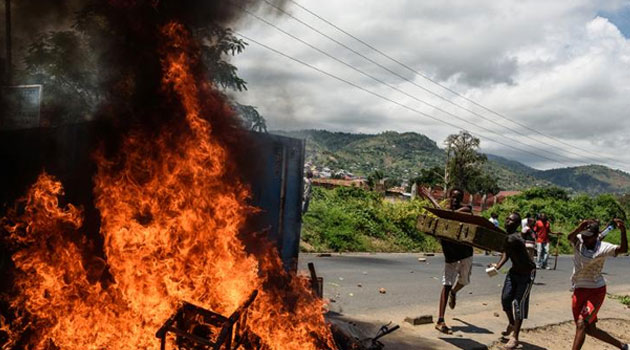
Fire in streets of Burundi as protestors continue with weeks of protests
But the other members of the East African Community (EAC) — Rwanda, Uganda, Tanzania and Kenya — which are tasked with either weighing in and forcing Nkurunziza to relent or letting his move slide, are seen as more likely attempting to paper over the cracks.
“It’s unlikely that the EAC countries will speak out over the question at the heart of the crisis. They’re not very well placed to do so because, apart from Kenya, they are all grappling themselves with the issue of presidential mandates,” explained Andre Gichaoua, an academic and expert on the region.
Ugandan President Yoweri Museveni is himself one of Africa’s longest-serving leaders, having seized power in 1986 and having changed the constitution to stay put.
He is also gearing up for re-election next year and, as a savvy regional player, appears to be keeping his options open on Burundi.
In Rwanda, moves are also afoot to move the political goalposts and allow President Paul Kagame — who has dominated Rwandan politics since his rebel army ended the 1994 genocide — to contest a third consecutive term in 2017.
In neighbouring DR Congo, too, President Joseph Kabila, who rose to power after his father Laurent-Desire was assassinated in 2001, is believed to be considering a third term bid to stay in power.
For their part, Burundi’s opposition say Nkurunziza’s third-mandate bid is both unconstitutional and a violation of the terms, and the spirit, of a peace deal that brought an end to the country’s civil war in 2006.
The president and his allies, however, have their own legal counter-arguments and show no sign of backing down.
– Will he turn up? –
So in Dar es Salaam on Sunday, the terms of the debate on how to tackle Burundi’s woes are likely to be narrow.
“Maybe they will talk about delaying the election date, and other minimal changes,” Gichaoua said, adding the issue of reopening private and independent radio stations — closed since they were attacked by Nkurunziza’s loyalists during the coup attempt — may also be addressed.
Thierry Vircoulon, an analyst with the International Crisis Group, said although the region’s leaders were deeply uncomfortable with Nkurunziza’s bid for a third term, mainly dues to fears it could push the country and region back into violence, “the official line at the moment is for a delay in elections.”
“It will be a surprise if they bring up the third mandate,” he said. “The bottom line is that a delay changes nothing, fixes nothing.”
It also remains to be seen if Nkurunziza even turns up to the meeting.
During the last mini-summit on the crisis in Dar es Salaam on May 13, he was stuck in a hotel while a general back home attempted a coup. It was only thanks to his loyalists in the presidential guard that the coup’s momentum was halted and he was able to return and reassert his control.
Burundi in the meantime remains gripped by almost daily protests, which have so far left at least 30 people dead, It has been wracked by internal divisions and also hit by international criticism.
Burundi’s influential Catholic Church said Thursday it was withdrawing support for June elections in the crisis-hit country, as the EU announced it was also suspending its mission to observe the vote.
Parliamentary elections are due to be held on June 5, with a presidential poll scheduled for June 26.
source: capital fm kenya