
Viktoria Modesta had difficulties in
birth that left her leg and hip dislocated. After 15 surgeries in
Latvia, she moved to London and was mercilessly bullied at school before
persuading doctors to amputate her leg.
The
video has already had eight million views and includes a beautiful
dance in which Viktoria spins on the black shard that extends from
above her knee and to a sharp point on the floor.
Wearing
fetish costumes, showing off long, toned limbs and showcasing a strut to
rival Beyonce's, Viktoria Modesta made her powerful pop debut on Sunday
night - as the ultimate bionic woman.
But
this singer - whose video Prototype aired on Channel 4 during the X
Factor final - is no ordinary popstar, she's an amputee who fought to
remove her painful, useless left leg so she could fulfil her dreams of
music success.
Now
the 26-year-old, who wore a shiny black spike as a prosthetic in the
sexy six-minute video, is determined to use her body and past to
challenge Britain's notions of disability.
Yet
this clever routine and glossily-styled shoot masks Viktoria's years
of pain, in which doctors told her mother to put her in a home and she
endured 15 operations - only relieved when she convinced UK surgeons
that her leg should be removed.
She tells FEMAIL: ‘I was born in Latvia when it was still in the USSR and my mother had a really complicated birth.
‘There was doctor's negligence during the birth which meant they dislocated my leg and hip.
‘After
that, there were several corrective procedures, including putting the
leg in a plaster when I was two weeks old, but sadly that actually
stalled the growth of my leg.
‘By
the time I was six, there was a considerable difference between my two
legs and I had 15 surgeries to try and correct the problem from then
until I turned 12.’

Viktoria as a baby with with her
mother Svetlana Moskalova. Doctors suggested Svetlana send Viktoria away
to live in a children's home, such was the stigma surrounding
disability in her home country of Latvia
While
growing up with a disability in any country is difficult, Viktoria says
that in the USSR, it was tantamount to a life sentence from the moment
she was born.
After
doctors realised there were mobility issues with her leg, they kept her
from her parents for five days and eventually advised that she was sent
away to live in a children’s home.
Viktoria
said: ‘Society in that time - they would have put me in a children's
home and hidden me away from the eyes of the public.
‘I'm
so thankful for my mother because she couldn't understand how society
could put such a burden on a defenceless, blameless child. She never let
me think I was anything but perfect.’
But although her parents gave her unlimited support, the outside world was much more cruel.
Throughout her childhood, Viktoria battled to be seen as anything other than a disabled child.
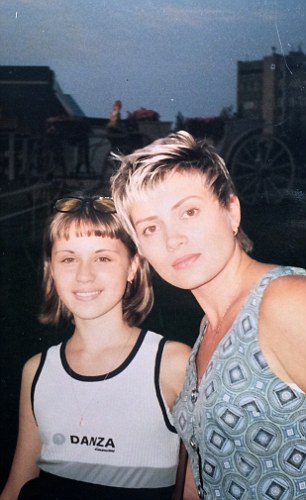

Viktoria as a young girl (left), as a teen (right, with her mother) was always interested in music
She said: ‘Growing up in Latvia, you can't be a stylish, intelligent person if you're disabled.
‘That was the propaganda that was placed on me.
‘Forget all of the superficial elements like the fact I couldn’t wear heels and skirts, it also really affected my physicality.
‘I couldn't do sport, I couldn't even walk for very long.
‘I was embarrassed because it made people not know who I really was.'
When
Viktoria and her parents immigrated to London and she started senior
school, her problems only worsened as her disability made her a target
for bullies.
She
said: ‘I barely went to school when I was in Latvia because I was in
and out of hospital and when I came to England, I went to school for a
couple of years and endured a lot of bullying.
‘It was very extreme, I can honestly say there were times in my teenage years when it was very difficult.
‘It was even more of a problem because the teachers weren't responsive to any of it.
‘I
ended up leaving school when I was 14 and I remember at the time,
social services actually threatened my parents with deportation because
they were saying I wasn't going to school, but I couldn’t because I was
being treated so badly.’

Viktoria makes a feature of her amputated leg, designing outlandish prosthetic limbs as part of her costumes
It
was only after Viktoria left school and started to focus on her music
and fashion that she began to gain confidence in herself.
She started to experiment with performance art and clothing, finding her sense of style.
But the inability to use her leg was a constant issue, making her embarrassed and ashamed.
She said: ‘By the time I was 16, I was starting to discover the direction of the person I wanted to be.
‘I
had strong interests in fashion, music and nightlife, but at the same
time, people would meet me in a crowded venue and think I had some
charisma and then think I didn't really follow through because of the
condition I had with my leg.
‘It really affected me on a day-to-day basis.’
Viktoria became convinced that the only solution was to have her leg amputated and went to a surgeon to ask for the operation.
But she was turned down.
She
said: ‘They felt that even though my leg was so damaged, it was still
my own and why would you get rid of a part of your body?’

Viktoria has spent the last few years honing her craft as a pop singer and turning her disability into a positive
Viktoria
then went away for several years and met up with various specialists
and people who deal with prosthetics, building her case so that she
could convince doctors to give her the operation.
She
said: ‘These experts told me that my life was going to be great after
the amputation, because with the help of false limbs I would feel
completely balanced.
‘It felt like a life or death situation at the time.
‘You
hear of people who undergo sex changes, where you are living in a body
but feel very disconnected with it - it was very much like I needed to
gain control of my own body.
‘After
a few years, I organised a meeting with a surgeon and presented him
with all of the facts that I had found and he agreed to go through with
the procedure.’
After her leg was removed, Viktoria says the relief was instant.
She said: ‘Immediately afterwards, I felt better.
‘Before, it felt like I had a map of negative history attached to me.
‘I'm
sure the morphine had a part to play, but waking up from the operation,
being able to move the covers, and not have anything there at all that
gave you any feelings, was amazing.
‘It wasn't negative, it wasn't positive, it was a clean slate.’
Since then, Viktoria has spent the last few years honing her craft as a pop singer and using her disability as a positive.
As
is evidenced in the music video for Prototype, she makes a feature of
her prosthetic limb, whether it is bejewelled or a menacing spike.
The
six-minute film cost Channel 4 £200,000 to produce and was created
simply with the aim of sparking a conversation about disability.


In the music video for Prototype,
Viktoria makes a feature of her prosthetic limb.The six-minute film cost
Channel 4 £200,000 to produce and was created with the aim of sparking a
conversation about disability
Viktoria
hopes the music video will launch a new discussion about people with
disabilities in this country, so that soon it no longer defines who you
are.
She
said: ‘I hope we are very close to the point where people understand
that the expectations for disabled people need to be raised
dramatically.
‘It isn't about finding someone inspirational just because they get out of bed.
‘I have met several people who work in the disabled community who say that attitude is really quite patronising and damaging.
‘It's about the encouragement of people like myself to come out and say there is a place for them if they are willing to work.
‘I
didn't get here by wishing that the world just accepted me, I got here
by working really, really hard and believing that the script that was
written for me wasn't the one that I was going to live.
‘But I do believe that the shift of power is in people like myself.
‘Because if you walk into a room and act like a victim and expect to be treated like that, then you will be.’
‘I think the world is generally moving into a more accepting place, but there is a long way to go.
‘It's still so shocking when you see someone with a missing arm on television.’
‘There is a lot of work to be done.’