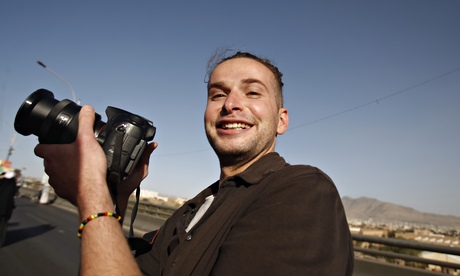
Barack Obama condemns ‘brutal murder’ of American photojournalist
British-born photojournalist Luke Somers and South African teacher Pierre Korkie die after US-led raid on hideoutLuke Somers,
33, an American photojournalist born in Britain who was kidnapped over a
year ago by al-Qaida and died in a US-led rescue operation. Photograph:
Hani Mohammed/AP
It was always going to be a high-risk operation. Tragically for the
two hostages held by al-Qaida militants in rural Yemeni, it didn’t come
off. US drones yesterday zeroed in on southern Yemen, firing a missile
that killed nine al-Qaida fighters. Then Yemeni jets strafed the area
and ground troops moved in, while American helicopters crammed with
commandos buzzed overheard.
But when the elite unit finally landed in a tiny village in southern
Shabwa province and burst into a string of homes, searching for American
Luke Somers, a 33-year-old photojournalist, and South African teacher
Pierre Korkie, it was too late.
“When forces entered the place where the hostages were being held,
they called on the kidnappers to give themselves up because they were
surrounded on all sides,” a senior Yemeni intelligence source told
Reuters news agency. “But the kidnappers immediately killed two
hostages, which prompted the forces to open fire on the kidnappers. They
tried to give first aid to the hostages but they had lost their lives.”
US forces airlifted Somers and Korkie to a navy warship, but both men
died soon after. Eight Yemeni civilians were also killed during the
raid, a tribal elder told the New York Times.
“The United States strongly condemns the barbaric murder of Luke
Somers at the hands of al-Qaida terrorists,” said President Barack
Obama, who added that he ordered the raid because “Luke’s life was in
imminent danger. As this and previous hostage rescue operations
demonstrate, the United States will spare no effort to use all of its
military, intelligence and diplomatic capabilities to bring Americans
home safely, wherever they are located.”
British foreign secretary Philip Hammond offered his condolences to
the families of both men and condemned the attack. He said: “Luke had
close links with the UK and his family have spoken about Luke’s life and
his work, and that is how he should be remembered. I salute the forces
involved, who showed great courage in carrying out this mission. We
continue to work with our international and Yemeni partners to counter
the threat from al Qaida and other terrorist groups.”
It was the second failed attempt in the last fortnight to release
Somers, who was snatched from outside a supermarket in the Yemeni
capital last autumn. The previous raid freed eight hostages held near
the Saudi border, but Somers had been moved several days earlier. On
Wednesday, his captors released a video of him pleading for help, and
threatened to kill him by the end of the week if their unspecified
demands were not met. That message may have pushed Washington, which
does not pay ransoms for American captives, to launch a second risky
rescue bid. The area of Yemen where the unsuccessful rescue operation took place.Photograph: Guardian
“Al-Qaida promised to conduct the execution [of Somers] today, so
there was an attempt to save them but unfortunately they shot the
hostage before or during the attack,” Yemen’s national security chief,
Major General Ali al-Ahmadi said at a conference in Manama, the capital
of Bahrain.
After Islamic State militants beheaded several British and US
prisoners, most recently aid worker Peter Kassig, Obama said
Washington’s approach to dealing with kidnappers was under review.
The failed raid highlights the challenges of rescue missions in
hostile territory. Somers and other hostages were believed to have been
held in chains in rugged mountain caves for much of their captivity.
Shabwa is a harsh area of craggy, volcanic peaks and desert plains that
alternate between punishing heat in the height of the summer and
freezing cold in the winter.
Korkie was killed the day before his kidnappers had promised to let
him go. He had been seized with his wife over a year ago, but her
January release appeared to have paved the way for another exchange. His
kidnappers had been demanding a $3m ransom.
“Pierre was to be released by al-Qaida tomorrow,” charity Gift of the Givers, which helped negotiate the deal, said in a statement. “Three days ago, we told [his wife] ‘Pierre will be home for Christmas’.”
The two American-led operations came after a long media blackout
surrounding details of Somers’s captivity. It also follows the execution
of three US hostages in Syria, James Foley, Steven Sotloff and Kassig,
and two Britons, David Haines and Alan Henning, who were all killed by
the Isis group.
Somers’s relatives, who had pleaded for him to be released, asked for
privacy. “We ask that all of Luke’s family members be allowed to mourn
in peace,” his sister Lucy Somers said. In her online plea for mercy,
she had said: “Luke is a gentle and sensitive person. He’s a romantic
and always believes the best of people. Photojournalism has been his way
of highlighting the struggles of the Yemeni people. Please let him
live.”
Last week’s video begins with a reading in Arabic from Nasser bin Ali
al-Ansi, an official of the terrorist group, before Somers appears and
gives a statement. “My name is Luke Somers,” he says. “I’m 33 years old.
I was born in England, but carry American citizenship and have lived in
America for most of my life. It’s now been well over a year since I’ve
been kidnapped in Sana’a. Basically, I’m looking for any help that can
get me out of this situation. I’m certain that my life is in danger.”
Ansi gave Washington three days to meet the demands or “otherwise,
the American hostage held by us will meet his inevitable fate”. The
three-minute video also features Ansi speaking about US activity in
Afghanistan, Somalia and Iraq as well as recent air strikes in Syria.